 |
| The figure of a performer filled with light, an image created by AI |
We are now at the most critical juncture of human civilization. The emergence of artificial intelligence, which was unimaginable just a few decades ago, is fundamentally shaking the identity of human existence by breaking down the boundaries between human thought and sense, labor and creation.
Artificial intelligence is no longer an assistive technology. Now, it writes on its own, creates images, and mimics human emotions and judgment. Some warn of the end of humanity, while others cheer that it is close to God’s act of creation, but at the center of this uproar, we are faced with one question: “Who exactly are humans, and where should we go?”
Technological advancement is an undeniable reality, but it does not necessarily mean the evolution of humans. AI may be able to accumulate information and calculate logic, but only humans can realize the meaning of life, reflect on suffering, and have awe for life and the universe.
At that very point, the current human race should not just create smarter machines, but should become more deeply awakened humans.
The outlook of futurists and AI experts that the current AI era will last for at most 5 years and that we will have to re-establish the direction of our existence after that is urging us to ask who will be the protagonist of the next era.
The answer is Homo Lumina. Derived from the Latin word ‘lumen’, this name does not simply mean a shining human, but rather ‘a human who has become aware of light itself’, in other words, a being who has awakened to the divine and cosmic essence.
Grammatically, adjectives such as ‘Homo Luminus’ or ‘Homo Luminosus’ may be standard, but ‘Lumina’ is a much more poetic, symbolic, and essential name. This is because it does not mean the external brilliance that existence emits, but rather a declaration of awareness that existence itself is united with the ‘essence of light’.
In fact, there is an important expression in Korean that corresponds to this. When a person’s face or a space is bright and clear, we say “hwanhada.” This word “hwanhada” goes beyond simply meaning bright, and means an inner light that dispels darkness and reveals the original form. If we look back at the depth of this word, we can see that it is not just an adjective but contains a philosophical awareness.
Furthermore, “Hwan-guk (桓國),” which is said to be the first state of ancient Korea about 10,000 years ago, also contains this character “hwan (桓, light)” in its name. “Hwan-guk” literally means a country of light, the center of a bright civilization, and this suggests that the roots of Korean spiritual culture are based on light, awakening, and unity with the order of the universe. This is also a deep spiritual connection with the new human image called Homo Luminaria.
If ‘Homo sapiens’ opened a civilization based on rational judgment and survival ability, ‘Homo lumina’ is the subject that opens a new civilization based on ethics, spirituality, and integrated consciousness beyond the limits of that civilization.
A new form of existence that lives with inner light at the center is needed, breaking away from the human form that pursued infinite expansion and separation through desire. That being is not a subject separated from nature, but a being that communicates with the universe as a part of nature, and does not consider others as competitors but exists in a network of living relationships that coexist. And that being realizes that it is not simply made up of flesh and thought, but is connected to the soul, divinity, and the order of the universe.
Naming something is like declaring an era. If ‘Sapiens’ explained the past of humanity, ‘Lumina’ illuminates the future of humanity. And now, from the moment we call that name, that future has already begun.
Humanity must now prepare to live in the next era through an ontological leap, not technological advancement. It is time to look at ourselves again in front of the mirror created by AI and build a new civilization as a ‘human of light’ who goes beyond that mirror.
‘Homo lumina’ is not some mythical ideal. It is the way of existence of those who are awakening even at this moment, and the language of life of those who have discovered the essence within themselves.
It is no longer an expansion toward the outside, but a return and transcendence through the inside, a transition to a higher level of consciousness. That is the true evolution that goes beyond the age of technology, and that path is the only answer that can protect the ultimate reason why humanity created AI and the value of existence.
That is why we must declare a new human image centered on ‘light’, not simply ‘intelligence’. That is the most fundamental answer to the current era of crisis, and the sacred key that opens a new civilization.
Now, we must say, “I am Homo lumina. I am light, and I am divinity.”
In the end, we all become ‘Hwan (桓)’...
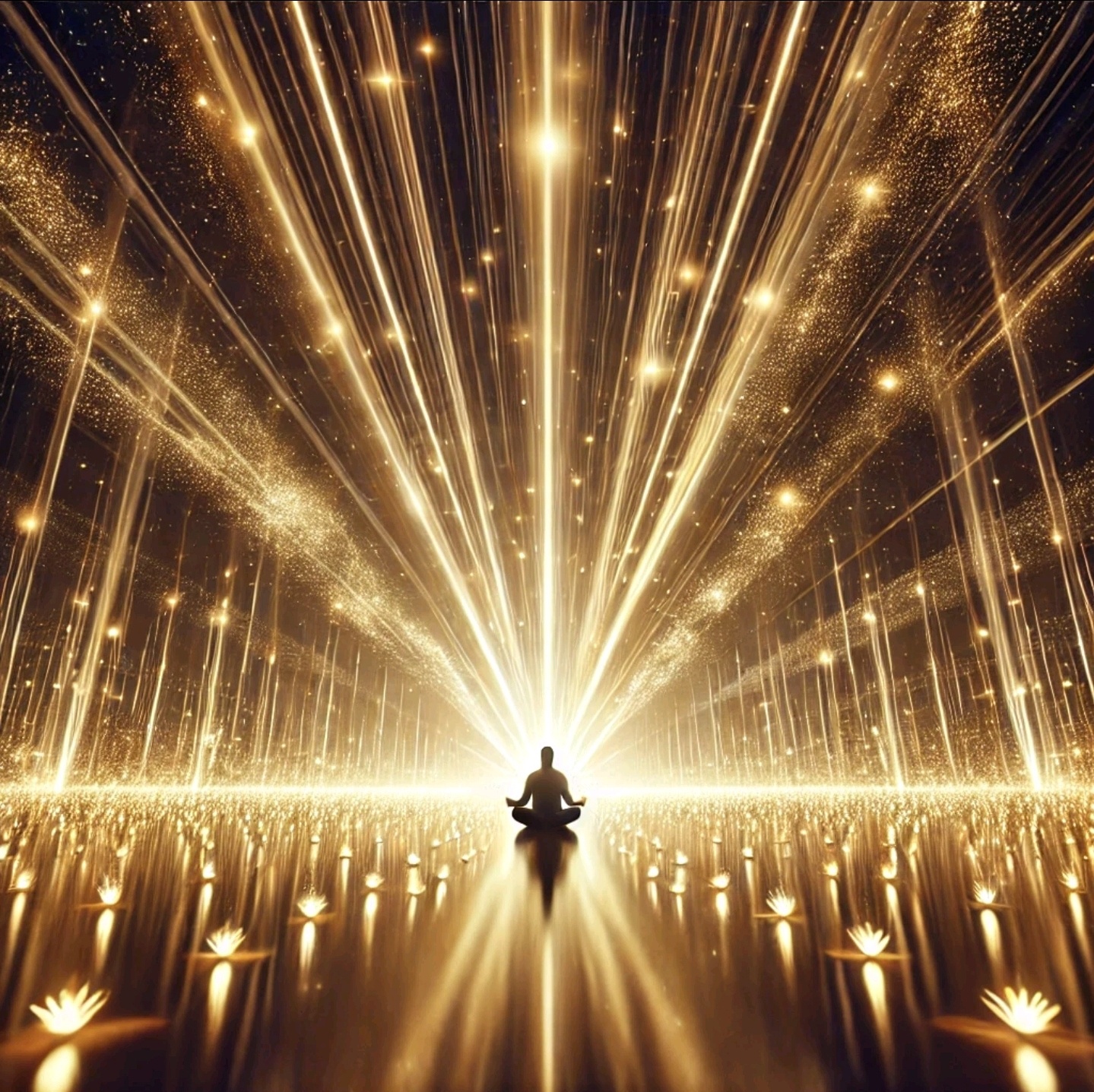 |
| The figure of a performer filled with light, an image created by AI |
<저작권자 © 한韓문화타임즈, 무단 전재 및 재배포 금지>
 ‘기문국’ 망령의 부활인가… 남원문화원은 누구를 위한 역사를 가르치는가