 |
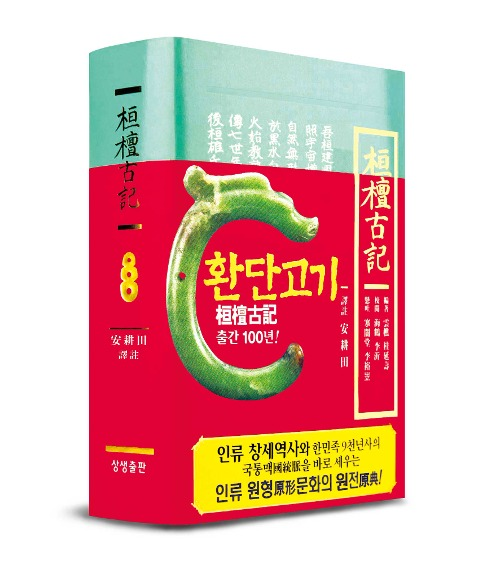
| Complete translation of Hwandangogi |
Every day, countless books and reports appear around the world, yet it is rare to find a work that preserves both the primal history and archetypal culture of the Korean people. One such work is Hwandangogi. As the late Professor Park Seong-su, the first president of the World Society of Hwandan History and Culture, emphasized, its complete translation marks the beginning of a spiritual and cultural revolution—a “second Renaissance” that seeks to correct Korean history and reframe world history.
For many readers, the first encounter with this book is startling. Learning that Korean history extends back thousands of years challenges the fragmented perspective found in textbooks and raises fundamental questions about identity and cultural roots. The narrative from Hwan-guk to Baedal to Ancient Joseon restores a sense of continuity that has long been missing.
The reason for this absence lies in modern history. Under Japanese colonial rule, the Government-General of Korea deliberately erased or distorted early Korean history: Dangun Joseon was relegated to myth, while Hwan-guk and Baedal were deleted altogether. After liberation, these distortions were not corrected but instead institutionalized within mainstream academia. To this day, many textbooks still describe Dangun Joseon as a legend, while efforts to challenge such orthodoxy are often sidelined.
In this context, Hwandangogi becomes more than a chronicle—it is a voice calling for historical restoration. Its philosophical ideas—Samsin (Three Divine Spirits), Hongik Ingan (benefiting all humankind), and the founding principle of Gaecheon (Opening of Heaven)—are not isolated inventions but resonate with themes also found in other traditional sources such as the Samguk Yusa, Dangi Gosa, and Gyuwon Sahwa. Together, they provide a framework for re-examining the roots of Korean civilization within a broader East Asian and global context.
Some critics have dismissed Hwandangogi as pseudo-history. Yet many of these critiques rely on assumptions rather than a close reading of the text. True scholarship requires engagement, comparison, and verification. Dismissing a work without study raises questions about academic fairness.
The significance of this book has already been demonstrated in history. Independence leaders such as General Hong Beom-do and General Oh Dong-jin reportedly supported its publication, recognizing its role in sustaining national spirit. If it were merely a forgery, it is difficult to explain why such figures would embrace it during the harshest years of struggle.
Today, as Korean culture resonates across the globe, the deeper values that underlie Hallyu—the vision of harmony between heaven, earth, and humanity—gain renewed importance. Hwandangogi reminds us that cultural flourishing is strongest when rooted in spiritual and historical depth.
Reading Hwandangogi, therefore, is not simply about revisiting the past. It is about reclaiming identity, restoring historical balance, and offering a broader vision for humanity. In this sense, it remains a call to open the door to truth and to take part in a new cultural awakening.
<저작권자 © 한韓문화타임즈, 무단 전재 및 재배포 금지>
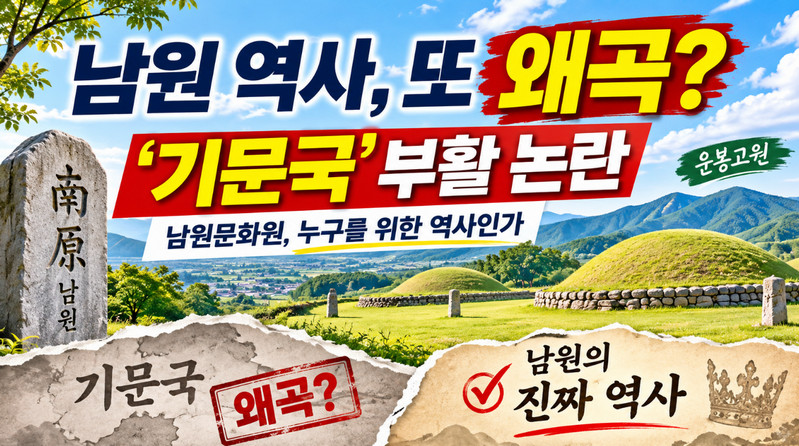 ‘기문국’ 망령의 부활인가… 남원문화원은 누구를 위한 역사를 가르치는가