“Arirang” is widely known as a song of sorrow and parting, yet its true essence transcends the boundaries of a simple folk song. It is one of humanity’s oldest lost cultural memories—a symbolic map guiding us toward a state of being where the human spirit merges with the light of the universe. To understand the true meaning of Arirang is to rediscover the very roots of primordial human culture.
While today it is recognized as a vessel for the Korean sentiment of Han (deep-seated longing and sorrow), a deeper look reveals a symbolic language speaking of the relationship between human existence and the cosmos.
The Code of Life: ‘Ari’ and ‘Rang’
The linguistic structure of "Arirang" offers a glimpse into the profound philosophical depth embedded within the word.
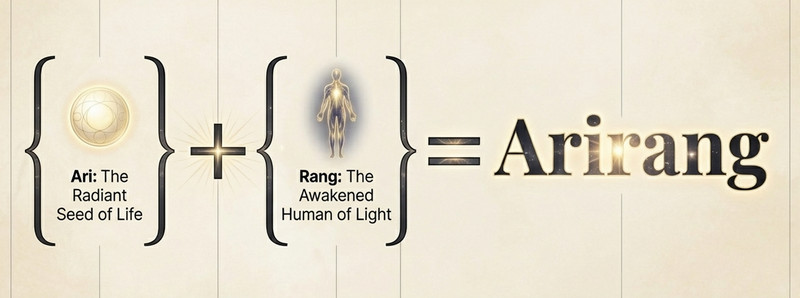
Ari (아리): This term is derived from the concept of Al (the egg or primordial seed). An egg represents a perfect, spherical form—the seed of life. Its roundness signifies the "Circle," symbolizing a center and a state of wholeness. Thus, Ari embodies the center of life, the radiant seed, and the core of existence.
Rang (랑): This title has been woven through the fabric of ancient East Asian culture for millennia. We see it in the Hwarang of Silla, the Nangga philosophy of Goguryeo, and various high-ranking titles. It goes beyond a simple suffix; it signifies a human being who has attained light or a soul of noble spirit.
In ancient Eastern thought, the bright, original nature of humanity was called Hwan (桓), meaning the eternal light dwelling within. When connected to this, Rang represents the human who has awakened to that inner light and lives by it.
Ultimately, Arirang represents the symbolic process of awakening the radiant seed of life (Ari) to become a human who embodies the cosmic light (Rang). It is a song of the journey back to our original brilliance.

Memories of Goddess Culture and the ‘Flower of Light’
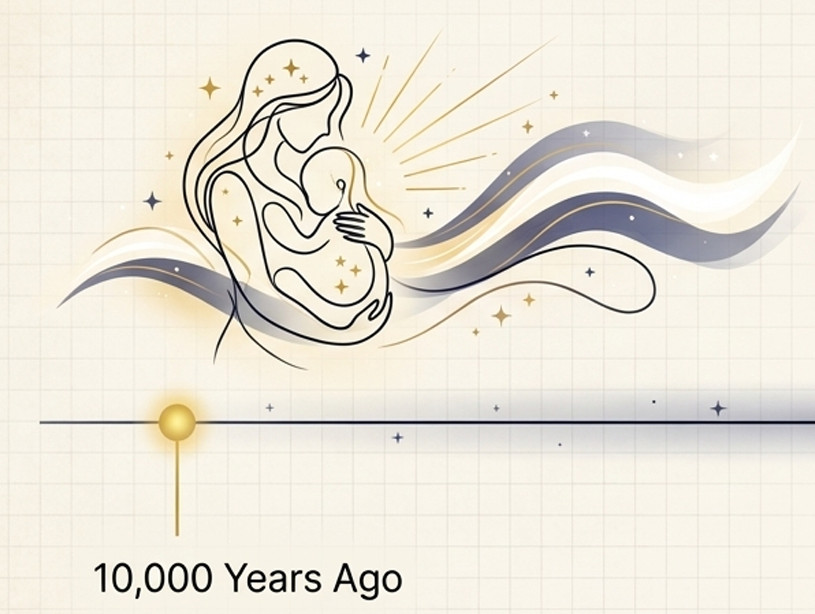
Tracing the origins of Arirang further back leads us to the most ancient memories of human civilization. Various traditions speak of a "Golden Age" roughly 10,000 years ago—an era of Goddess culture where life, nature, and the universe existed in a single, harmonious order.
At the heart of this culture was the role of the Mother as the transmitter of the light of life. It is said that the Mother bestowed the vital energy of life upon the fetus, maintaining the consciousness that humans are beings eternally connected to the cosmic light.
The symbol passed down from this era is the “Flower of Light.” It represents the radiance of life blooming within the human soul, sometimes referred to as Yullyeohwa (the Flower of Cosmic Resonance). It symbolizes the experiential awakening of one’s original light.
The Turning Point of Civilization and Archetypal Intelligence
Humanity now stands at a massive civilizational crossroads. Technological advancement is breathtaking, and we have entered the age of Artificial Intelligence (AI). While life is more convenient than ever, the question of human identity has never been more pressing.
As technology advances, we face the growing concern that we may be losing our innate human faculties and senses.
Consequently, many modern thinkers are calling for a restoration of Archetypal Intelligence (AI). This is not mechanical calculation, but the original intelligence of humanity—deeply interconnected with nature, the universe, and the essence of life itself.
In ancient Eastern worldviews, humans were understood as the "Children of Heaven and Earth." This Heaven-Earth Parent consciousness awakens the sense that we are not separate from nature, but one with the universe. The song of Arirang carries this very "Archetypal" human consciousness within its melody.
We Are All Arirang
If we view Arirang merely as a song of sad parting, we miss more than half of its profound meaning.
Arirang is a symbolic narrative of the human journey toward our original light. It is the process of awakening the Ari (seed of life) and evolving into the Rang (human of light).
As human civilization faces a new era of transformation, Arirang poses a singular question:
“Where did humanity come from, and where must we go?”
Arirang is the response to that question. It is a declaration that humans came from light and are destined to return to light.
Thus, Arirang is not a folk song of the past; it is the ongoing story of humanity. The refrain "Arirang, Arirang, Arariyo" may be an ancient calling, echoing to wake the memories we have long forgotten.
The moment we realize the weight of that call, we understand:
Arirang is not the name of a song—it is the true name of humanity itself.
 |
출처 : 노트북LM을 통한 생성 이미지
유수연 기자 miracle2005@naver.com
<저작권자 © 한韓문화타임즈, 무단 전재 및 재배포 금지>
 ‘기문국’ 망령의 부활인가… 남원문화원은 누구를 위한 역사를 가르치는가